News

The $20 DIY Brake Pressure Bleeder

The $20 DIY Brake Pressure Bleeder

You’ve heard me extol the songs of brakes and brake fluid, and how its important to change it every two years.
I’d like to take credit for this idea, but I got it from this page.:

http://www.bmw-m.net/TechProc/bleeder.htm – Here’s another one too. http://www.bayarea02.com/techtips/brake_bleeder.html

And his idea was good. But I felt I could do better, for less. I have a lot of VWs to care for, and one of the pains is bleeding the brakes. I like pressure bleeders, they do a great job. This one I made up works super, and it can be built with minimal tools in less then an hour.

Look, here’s the same thing I made for less money…. wow $114.99 LESS!!!

You’ll need some basic hand tools and a Dremel with a stone cone-shaped bit or a drill and a set of bits. I just eyeball stuff when I build. A wise man told me “Cut Twice, Measure Nunce.”

You’ll want to use a NEW sprayer tank, don’t go grabbing whatever you see in the shed, or was used last summer to kill weeds. Brake fluid is picky about where it has to live. Make sure to blow the tank out, and the lines before you use it the first time.

This pressure bleeder will (like all of them) will fill your master cylinder up to the very top. A way to prevent this from happening is, on the last wheel your bleeding, to close the pressure line on the bleeder with the switch on the handle of the tank, and then vent the pressure in the tank. Then bleed out the excess fluid VIA the wheel cylinder or caliper. Or, use a cheap dollar store turkey baster to suck the excess out of the master cylinder.

This little ditty will work wonders for your VW’s brakes, or hydraulic clutch on your VR6 or Vanagon.. well, just about any European car! So on with the show…!

Basic Rules, clean brake fluid up with cold water. Keep all fluids, water, dirt, and oil out of the brake system (except for clean brake fluid). Keep brake fluid off all painted surfaces. If brake fluid comes in contact with paint, wash it off IMMEDIATELY with cold water!

Shopping List:
With the exception of the brake fluid cap and the tire valve stem, everything can be had at your local Home Depot or quality hardware center.

1 – RL FlowMaster 1 Gallon Sprayer Model 1401HD – $8.00
1 – Watts A-192 1/4″x1/4″ MIP Hose Barb Adapter $1.50
1 – Watts A-778 3/8″ MIP x 1/4″ FIP Pipe Bushing – $1.50
1 – 10′ section of Watts 3/8″ vinyl clear tubing – $2.50
1 – ATE N3030-33314 Master Cylinder Cap – Found locally $5.00

This was OEM for these cars:
Mercedes Benz 190E 1986 – 1987
Mercedes Benz 280SEc/c 1968 – 1970
Mercedes Benz 300CD 1978 – 1981
Mercedes Benz 450SE 1973 – 1975
Volvo 760 V6 1983 – 1986

Its a 100% perfect direct fit for the VWs (as well as, well just about every BMW, Volvo, Mercedes and so on..).

This cap is great for this project since it does not have the float switch mounted in the center of it.

Stuff I had on hand, so I call it free.

2 – Small washers
2 – Small “O” Rings
1 – Bolt-on style chrome tire valve stem.

The Cap.

This wonderful cap, so expertly designed by ATE labs (pronounced Ah-Tay, its German).. has a small hole in it. This hole has an interesting story behind it. All master cylinders have to have some way to allow the fluid level to drop over time. If not they would create a vacuum and the fluid would cavitate in the system causing it to bubble. The cap, is a breather vent. By holding it up to the light, you can see it. Older domestic cars had a cast iron master cylinder and a flexible membrane that would have fresh air behind it, and keep the brake system 100% moisture free., But the ATE design does not work that way, with a plastic brake fluid reservoir you cannot have a large metal clamp like the US designs. the ATE design was years ahead of its time, being much lighter weight. Anyhow, enough of the history lesson.

See that, part Watts #A-778 just fits in there. Pry off the cap. toss it.

Follow the directions and build the sprayer. If you get lost at this point, your hopeless. Might as well go to a Suicide Booth.

Take your Dremel with small average sized cutting stone, cone shaped. Its like 3/8″ of an inch in size.

Grind hole in cap. I guessed here. I’m not an engineer.
And engineer would overdo this, measure, cut, measure, cut… screw that.
I have brakes to bleed.

Cut away flashing from cut

Take Watts A-192 Hose Barb Adapter, washer, and O ring.

Screw into cap.

Don’t crush the O-ring. Just snug it down.

Screw on the bottom half of the hose bar (A-778). If needed, use another washer or O-ring here.
Play around with it. – That’s it, its done.
No glue, RTV, or anything.
Snug everything down.

Install your clear tubing, install a small hose clamp.

Wire nip off the end of the wand from the Sprayer Kit. Jamb the hose on the end of it, and then

Now you can use the handle on the sprayer to start/stop the flow of the bleeder at will.
Best of all with 10′ of tubing you can use this on a lift, or at the back wheel and control the flow, watch the fluid level in the tank. Nice!

At this point, you could use your bleeder. But hold on, its going to get even better!

Take apart your Bolt on Tire chrome valve stem.

Dremel a hole (using the same bit you did before) in the side of the tank. Make sure its not on a seam of the tank. And make sure its near an area that you can reach your fingers into.

While the plastic is still hot hand tighten in the butt of the valve stem into the tank. This will create threads.

Remove the stem and blow out the tank with compressed air. Remove all “flashing” from the tank with a small blade and your fingers. ya know, rough plastic bits.

Thread the stem in from the inside. Its tight, but I could do it. So can you. Might need a beer at this point.

Pump it up, see how much pressure it can hold. Cool eh? Not only can you check the pressure this way, BUT you can FILL it with an air compressor, OR bleed the excess air out of the tank when you are finished! Sweet!!! (Note: always bleed excess air from the tank before storing it. This will prolong the life of the seals and reduce the stress on the valves.)

Make sure to test it before you put brake fluid in it. I just held my thumb over the lower half of the cap and listened for air leaks.

Most cars are bled at about 20-30 PSI. Some are as low as 10. See what works good for you. Don’t EVER push more then say… 50 PSI… you’ll rupture the master cylinder. Keep an eye on the fluid level in the bleeder tank, you don’t want it to go dry and push air into the system! And again, you may wish to add a hose clamp on the end of the line where it meets the cap just as an extra safety measure.

Finished and workin’ FINE!
Electrical safety in your vintage Volkswagen

This past weekend I experience an event that I hope nobody ever has to experience. Jill was re-arranging items behind the backseat of the bug and all of the sudden, there was smoke billowing from under the seat. I quickly pulled the bottom of the seat out to find that she happened to kneel down right on top of the positive battery post of the battery. The coils of the seat were touching the battery post which in turn shorted it out and the coils got super hot. Once the coils were hot enough, they started to burn the horsehair on the underside of the upholstry.  So the lessen to learn here is to get some sort of rubber post protector installed on the positive lead of your battery. This will put a piece of rubber between the two metals and hopefully protect you from a future fire.  We got lucky.

It wouldn’t be such a bad idea to look at or have a qualified techincian look at the whole electrical system on your car. Check to make sure that all connections are tight and not arcing. Pay close attention to your battery connections. If the terminals are loose, they can sometime arc and with enough arcing, the battery can actually fail when you need it the most.

Another good area to check out is your fuse block. From the trunk side of the dash, inspect that the wires are all connected and that the terminals are tight on the fuse block. On some older cars, the terminals can loosen with age and you’ll notice that some lights, your horn, or whatever won’t work right anymore. You can simply cut the terminal off and crimp on a different one.  Of course, before you do any work with your electrical system, make sure that you disconnect the battery.  From the interior of your car, take the fuses out one by one to inspect. Take some scotchbrite wool and clean up the ends of the fuses or the fuse holders to make sure you have good continuity between the two items.

If you for some reason have something that isn’t working right, first check your electrical connections, then check your grounds. If it isn’t one of the two, then look into it a little farther.

Good luck and be safe. We want you all around as long as you can be for all the fun we will have throughout the years. 

– Joel

Acquiring a valid title for your VW in North Dakota

Ever had  an old VW that was pulled out of obscurity and no title was anywhere to be found? Joel Herman details the steps required to get that Dub back in the good graces of the state of North Dakota. The following are the exact steps you need to follow to get your vintage Volkswagen titled in North Dakota (as of 7/23/2021).

You will need to visit the following site and download the following form.  North Dakota DOT Form


Here is the form contents copy and pasted:

UNTITLED VEHICLES
37-12-04-01 (NDAC)
ALL DOCUMENTS REQUIRE ORIGINAL SIGNATURES
23-JUN-2021
Untitled Vehicles will be reviewed by the Bismarck Central Office, the title will be mailed once the review
process is complete.
If a North Dakota resident(s) owns a vehicle for which the resident(s) is unable to obtain a proper certificate of
title, the Motor Vehicle Division will use the following forms and procedures to determine ownership of a
vehicle and issue a certificate of title. All applicants applying for title through the untitled vehicle process
must be North Dakota residents.
1) Complete a NMVTIS Vehicle History Check to verify no certificate of title or ownership record exists in
exists in this database.
a. A NMVTIS Vehicle History Check may be purchased through an approved provider at
www.vehiclehistory.gov.
b. If a certificate of title or ownership record is found in any state, the Untitled Vehicle process cannot
be completed.
*** A records search is also conducted by the Motor Vehicle Division during processing of Untitled
Vehicle applications; additional records may be found at that time. ***
c. If a North Dakota record exists and information to obtain a duplicate title or title transfer is needed, a
Request for Vehicle Information form SFN 51269 will need to be filled out, with the number eleven
exception initialed, and submitted with payment of the $3 fee. The Administrative Rules Chapter 37-
12-04-01(4) is the law that allows the release of this information. This should be notated on the
required document with detailed explanation outlining the qualifications for access under this exception
that must be attached to the SFN 51269 form.
2) Upon receipt of the following, North Dakota Motor Vehicle will start the title process. All UntitledVehicles
will be reviewed. A record check of all states will be conducted to verify no certificate of title or ownership
record exists, as well as a check of the National Crime Information Center, before issuing a North Dakota
Certificate of Title.
All forms must be completed in full, printed or typed, with legible information and signed as
indicated. Fillable PDF forms are available online at dot.nd.gov under Forms.
a. Results of the NMVTIS Vehicle History Check.
b. Photo of the VIN plate.
c. A notarized SFN 2888 Seller’s Certificate and Vehicle Bill of Sale.
i. Seller should provide the reason why a title cannot be furnished.
UNTITLED VEHICLES
37-12-04-01 (NDAC)
ALL DOCUMENTS REQUIRE ORIGINAL SIGNATURES
23-JUN-2021
d. A Notarized SFN 2903 Vehicle Statement of Ownership.
i. You must be detailed in your explanation regarding how you came into possession of this vehicle
without a title.
e. A VIN inspection utilizing SFN 2486 Certificate of Vehicle Inspection.
i. Inspection must be completed by a Qualified Business registered with the North Dakota Secretary
of State, which offers motor vehicle repairs to the public, per NDCC 39-05-20.2.
ii. You must include a copy of the current North Dakota Secretary of State filing for the
inspection facility, which can be obtained directly from the Secretary of State’s website.
f. SFN 2872 Application for Certificate of Title & Registration of a Vehicle.
g. $5 title fee, $1.50 Abandoned Vehicle Disposal Fee and 5% Motor Vehicle Excise Tax.
i. Tax is calculated based on the current Fair Market Value of the Vehicle. Dealer appraisal may be
requested.
h. Registration Fees.
i. SFN 60689 Statement of Fact is required if the vehicle will not be registered.
ii. A vehicle inspection utilizing SFN 2486 Certificate of Vehicle Inspection may be required prior
to registration if the vehicle is rebuilt, modified, antique or homemade.
i. Current photos of the front, side, and rear of the vehicle.
j. Proof of North Dakota residency is required for all owners.
i. All individuals must provide a North Dakota Driver’s License/State ID number.
ii. Businesses must provide a current North Dakota Secretary of State filing indicating the State of
Origin as North Dakota which can be obtained directly from the Secretary of State’s website.
k. Any other information required by the department per NDCC 39-05-05.

Fuel filters and your Volkswagen

This is a subject that has been covered many times by many different people, but I’m going to show you the consequences if you do this the wrong way.

The subject:  Fuel Filter

When installing a fuel filter in your vintage Volkswagen, there are many options that you can buy from the parts stores. Many go with a clear plastic fuel filter that you can buy for under $2.00. This is an option that I highly suggest you do not use. I always use metal fuel filters on my cars because of their durability and effectiveness. Metal filters do not easily burn and are built a lot better overall.

Part numbers I have for the filters I use:  Duralast FF3404DL and WIX 33031 Fram G1

Where do I install a fuel filter?

A lot of cars that I’ve worked on and seen at shows/cruises have the fuel filters installed on the hose that is connected directly to the carburetor. It works but is not a safe placement, in my opinion, due to the fact that it is a highly pressurized hose an is fed directly from the fuel pump. There should be nothing other then a hose running from the fuel pump to the carburetor.

I place my fuel filters above or around the transmission right after the fuel line comes out of the tunnel.  As long as you use the metal filters this is a safe place to install an inline filter. You could also install a filter underneath the gas tank inline before the line goes into the tunnel of the car. Simply use a zip tie or such to make sure that the filter is tied up out of the way of anything that moves or couldpossibly rub on.

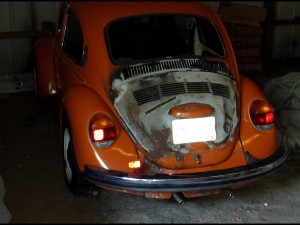
Attached are photos of a car that I recently saw that caught fire because of the plastic fuel filter in the engine bay. The filter simply came apart and the fuel was pumped all over the hot, running engine. The owner was able to get the fire put out quickly, but as you can see in the pictures, a little fire goes a long way.

I hope this helps you all. I don’t want to hear about anyone’s cars catching fire because of this. If any of you would like help installing a new filter or simply would like someone to look over your car to make sure everything looks safe, please get a hold of me or Jayson Ackerson and set up a time to get everything looked at.

Safe driving,

Joel